Two filters can both say "10 micron" and "high efficiency" on the label and still protect your equipment very differently. The difference lies in how that efficiency is measured and in the material the filter element is made of.
Nominal filter: a number without a standard
A nominal rating says the filter captures "some" of the particles of a given size, but there is no single standard defining how many, or under what conditions it was measured. Each manufacturer uses its own criteria.
In practice, a 10 micron nominal filter can let a large share of particles of that size through. And because the figure does not come from a standardized test, it cannot be compared with another filter.
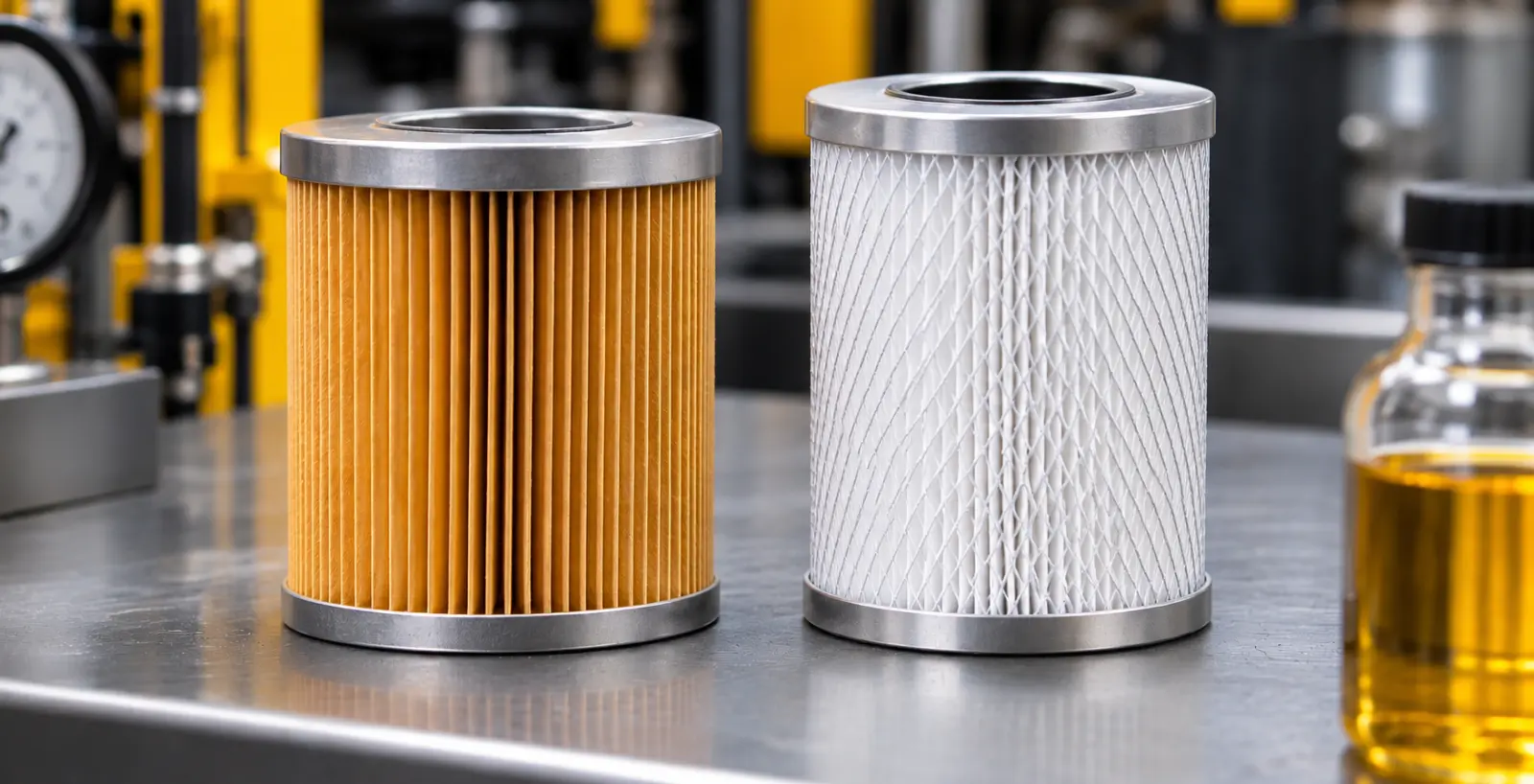
Many nominal filters are made of cellulose or paper. Even when sold as "high efficiency", this material has limitations:
- Irregular fibers, with pores of different sizes that let larger particles through than stated.
- Lower dirt-holding capacity, so they plug sooner.
- Sensitivity to water: cellulose absorbs moisture, swells and loses strength.
- Less stability under pressure and changing flow, which can release contaminants already captured.
Absolute filter: measured, verifiable efficiency
An absolute filter is rated by its Beta ratio (β), obtained in the multi-pass test of the ISO 16889 standard. The test counts how many particles of a given size there are upstream and downstream of the filter:
βx = particles upstream of the filter / particles downstream of the filter (equal to or larger than x microns)
For example, β10 = 1000 means that for every 1,000 particles of 10 microns or larger reaching the filter, only one gets through.
What each filter lets through
If 1,000,000 particles of 10 microns or larger arrive:
| Beta ratio | Efficiency | Particles that pass |
|---|---|---|
| β = 2 | 50% | 500,000 |
| β = 200 | 99.5% | 5,000 |
| β = 1000 | 99.9% | 1,000 |
| β = 4000 | 99.975% | 250 |
The gap between 99.5% and 99.975% looks small as a percentage, but in the oil it means 20 times fewer particles circulating through your equipment.
Absolute filters are usually made of glass microfiber or synthetic media: uniform fibers, controlled pores, higher dirt-holding capacity and stable behavior with water and pressure.
Why it matters for your equipment
Fine particles cause the most wear in pumps, valves, bearings, servo valves and injectors, because they get into the clearances between moving parts. A filter that lets thousands of particles through on every pass keeps the oil dirty no matter how often it is changed.
With absolute filtration you get:
- Cleaner oil, with a better ISO 4406 cleanliness code.
- Longer life for components and for the lubricant itself.
- Fewer failures and unplanned stops.
- More predictable change intervals.
The cheapest filter per unit is rarely the most economical once you add the cost of repairing a pump or stopping a production line.
How Venefilter can help
We are official representatives of Hy-Pro, Donaldson and Schroeder, and we have our own line of Venefilter filter elements with high-efficiency media and certified Beta ratings. We help you choose the right element for each machine and, with Tribo-Labs fluid analysis, we verify with data that your oil reaches the target cleanliness level.
Contact us to assess the filtration on your equipment or to request a quote for filter elements.
Frequently asked questions
Is a "high-efficiency" filter the same as an absolute filter?
Not necessarily. "High efficiency" is a marketing term. What confirms real efficiency is the Beta ratio measured under ISO 16889.
Which Beta ratio should I ask for?
It depends on the equipment and the cleanliness level the manufacturer requires. For critical hydraulic and lubrication systems, the recommendation is to work with β ≥ 1000 at the stated particle size.