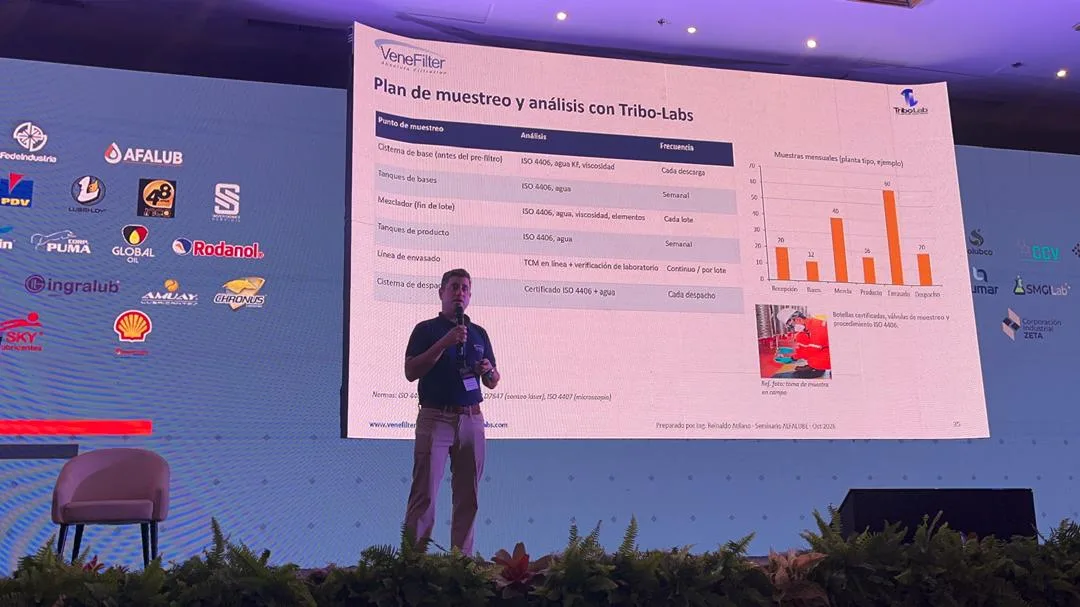
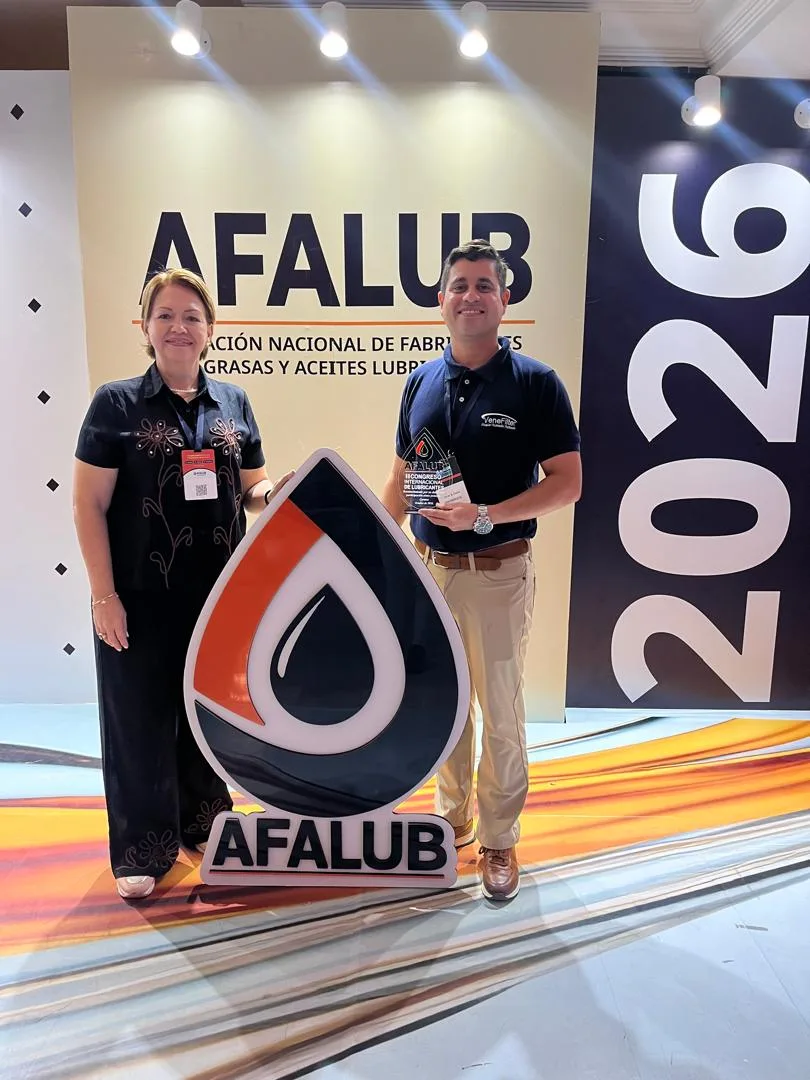
On October 30 we took part in the 2nd AFALUB International Congress, organized by Venezuela's national association of grease and lubricating oil manufacturers, in Caracas. The seminar was given by Javier Arcia, a Venefilter engineer, who covered a topic that affects the whole industry: how to make sure lubricant leaves the plant clean. This article sums up his talk.
New oil is not always clean oil. Up to 82% of component wear is caused by particles, and the most harmful ones measure between 1 and 10 microns, far below the 40 microns the human eye can see. If the lubricant leaves the plant contaminated, it starts wearing the customer's equipment from the very first fill.
The problem: contamination gets in at every stage
In a lubricant plant, dirt does not come from a single place:
- Environment: dust and moisture entering through vents, tank hatches and open pails.
- Handling: every transfer between tanker, tank, blender and container adds particles. An oil can be moved from one container to another up to eight times before it reaches the machine.
- Water: condensation inside tanks and leftovers from washing.
- Internal wear: pumps, valves and blenders generate particles.
- Installation: weld slag, rust and assembly debris.
Meanwhile, equipment manufacturers (OEMs) demand ever stricter cleanliness levels, measured with the ISO 4406 code. Typical new drum oil arrives at 22/20/18, but an engine requires 18/16/13 and a hydraulic system 16/14/11. That means 16 to 60 times fewer particles than uncontrolled oil carries.
The Venefilter solution: a barrier in every area of the plant
At Venefilter we apply contamination control across the four areas of the plant.
1. Base oil receiving
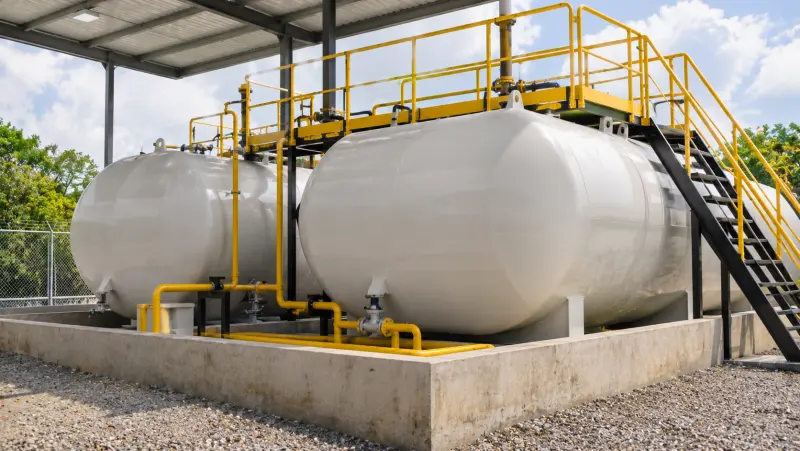
Tanker unloading goes through 25 micron nominal pre-filtration that captures rust, slag and sediment before they enter the tank. Each base oil is stored in its own tank by viscosity to avoid cross-contamination, and the tanks are fitted with 2 micron silica gel breathers that block dust and moisture every time the tank "breathes".
2. Blending and additive dosing
This is where quality is defined. Each blender is connected to a recirculation filtration unit (a kidney loop) with absolute filter elements, which recirculates the product several times per batch until it reaches the target cleanliness code.
3. Finished product storage
The goal is to keep clean what has already been cleaned. We use high-efficiency silica gel breathers or, for critical products and tropical climates, dry air systems that fill the tank headspace with very low-humidity air. That slight positive pressure stops the tank from drawing in moisture or dust from outside.
4. Packaging
This is the last barrier before the customer. Each line has a final absolute filter sized for the product's viscosity and an inline laser particle counter that stops the filler if the cleanliness code goes over the limit. On open pails, flexible covers keep dust from falling onto the product between filling and capping.
Nominal or absolute: each filter in its place
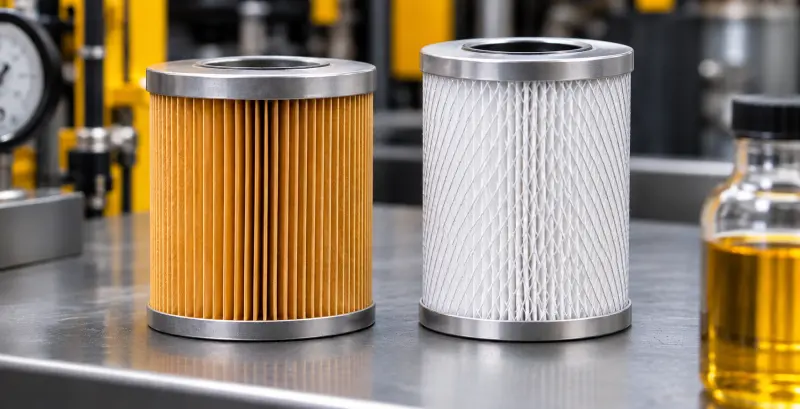
A nominal filter, usually cellulose, may capture only half of the particles at its rated size. An absolute glass microfiber filter can capture more than 99.9%. The rule is simple: nominal filtration at unloading to protect the tank, and absolute filtration where product quality is defined. We explain this in more detail in nominal vs. absolute filters.
Measure before release
No batch should leave the plant without data. With Tribo-Labs we set up a sampling plan at every tanker unloading, in the tanks, at the end of each batch and at every dispatch, with ISO 4406 particle counting, Karl Fischer water and viscosity. Product is released only if it meets the OEM requirement for its family, and every bulk shipment leaves with its certificate of analysis.
Protect the quality of your product
Venefilter supports lubricant plants with contamination audits, filtration skid design, breathers, dry air systems, laser monitoring and operator training. Contact us to assess your plant's cleanliness level or request a quote.
Thank you to AFALUB and to all the manufacturers who joined us in Caracas. See you at the next edition.